What is the phase of the business cycle where output and employment levels begin to rise?
What is a Business Wheel?
A business cycle is a cycle of fluctuations in the Gdp (Gross domestic product) around its long-term natural growth rate. It explains the expansion and contraction in economic action that an economy experiences over time.
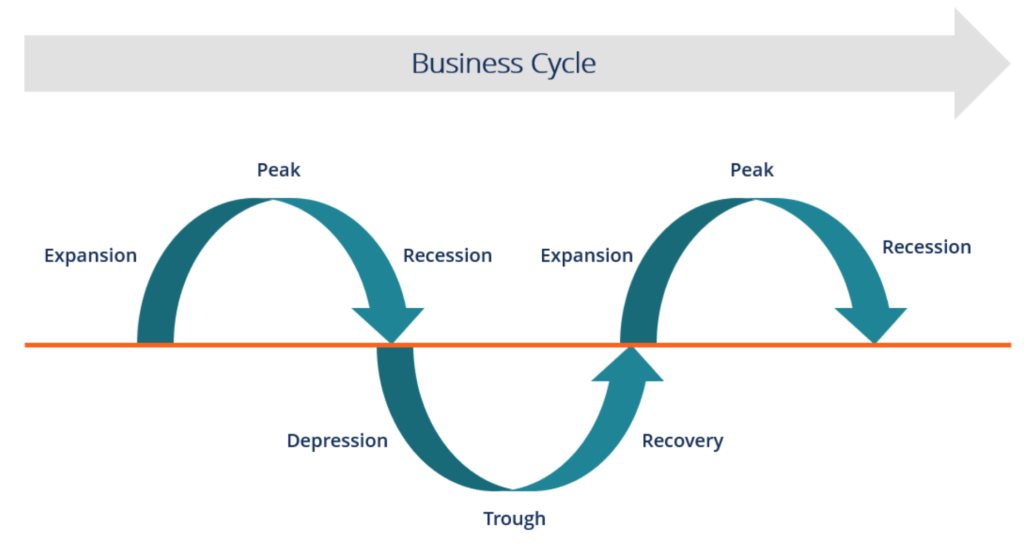
A business bike is completed when it goes through a single smash and a single contraction in sequence. The fourth dimension period to complete this sequence is chosen the length of the business organization cycle. A boom is characterized by a period of rapid economic growth whereas a period of relatively stagnated economical growth is a recession. These are measured in terms of the growth of the real GDP, which is inflation-adjusted.
Stages of the Business Cycle
In the diagram above, the straight line in the middle is the steady growth line. The business bike moves about the line. Beneath is a more than detailed description of each stage in the business cycle:
ane. Expansion
The first phase in the business cycle is expansion. In this stage, there is an increment in positive economical indicators such as employment, income, output, wages, profits, need, and supply of appurtenances and services. Debtors are more often than not paying their debts on time, the velocity of the money supply is high, and investment is high. This procedure continues as long as economic conditions are favorable for expansion.
two. Peak
The economy and so reaches a saturation point, or top, which is the second stage of the business cycle. The maximum limit of growth is attained. The economic indicators do not grow further and are at their highest. Prices are at their meridian. This stage marks the reversal point in the trend of economic growth. Consumers tend to restructure their budgets at this point.
three. Recession
The recession is the phase that follows the peak stage. The demand for goods and services starts declining rapidly and steadily in this stage. Producers do not notice the decrease in need instantly and get on producing, which creates a situation of excess supply in the market. Prices tend to fall. All positive economic indicators such as income, output, wages, etc., consequently start to fall.
four. Depression
There is a commensurate rise in unemployment. The growth in the economy continues to decline, and as this falls below the steady growth line, the stage is called a depression.
5. Trough
In the depression phase, the economy's growth rate becomes negative. There is further refuse until the prices of factors, too equally the demand and supply of goods and services, contract to reach their everyman point. The economic system eventually reaches the trough. Information technology is the negative saturation bespeak for an economy. At that place is extensive depletion of national income and expenditure.
half-dozen. Recovery
After the trough, the economy moves to the stage of recovery. In this phase, in that location is a turnaround in the economy, and it begins to recover from the negative growth charge per unit. Demand starts to choice upward due to low prices and, consequently, supply begins to increment. The population develops a positive attitude towards investment and employment and product starts increasing.
Employment begins to rise and, due to accumulated greenbacks balances with the bankers, lending also shows positive signals. In this phase, depreciated capital is replaced, leading to new investments in the product process. Recovery continues until the economy returns to steady growth levels.
This completes one full business cycle of boom and contraction. The extreme points are the superlative and the trough.
Explanations by Economists
John Keynes explains the occurrence of business organization cycles is a result of fluctuations in amass need, which bring the economy to brusk-term equilibriums that are unlike from a full-employment equilibrium.
Keynesian models exercise not necessarily signal periodic business organization cycles simply imply cyclical responses to shocks via multipliers. The extent of these fluctuations depends on the levels of investment, for that determines the level of aggregate output.
In contrast, economists like Finn Eastward. Kydland and Edward C. Prescott, who are associated with the Chicago School of Economics, challenge the Keynesian theories. They consider the fluctuations in the growth of an economy non to be a issue of monetary shocks, only a result of engineering science shocks, such equally innovation.
Additional Resource
Thank you lot for reading CFI's guide to Business Cycle. To learn more than, bank check out these boosted CFI resources:
- Law of Supply
- Normative Economic science
- Cyclical Unemployment
- Inelastic Demand
Source: https://corporatefinanceinstitute.com/resources/knowledge/economics/business-cycle/
0 Response to "What is the phase of the business cycle where output and employment levels begin to rise?"
Post a Comment